Platform selection driven by vendor relationships, existing enterprise agreements, or engineering preference, rather than workload fit and managed service availability, creating years of operational friction and cost inefficiency.
Moving virtual machines to a cloud landing zone without refactoring for a multi-cloud strategy (managed databases, autoscaling, serverless, and object storage) results in infrastructure that costs more than on-premises and performs no better.
Over-permissive IAM roles, publicly accessible storage buckets, missing network segmentation, and unrotated secrets are endemic in cloud environments built quickly without a security baseline. The cloud landing zone design is where this is fixed, not after an incident.
Without tagging, budget alerts, reserved capacity planning, and ownership frameworks, cloud bills become a quarterly surprise rather than a managed variable. Cost governance is an architecture decision, not a finance team problem.
We embed robust security baselines into every cloud environment from day one, ensuring compliance and data integrity are baked into the architecture rather than bolted on.
With us, zero-downtime goals are supported by mandatory, tested rollback plans that enable seamless transitions and full risk mitigation during complex system cutovers.
We eliminate the ‘knowledge silo’ by delivering comprehensive documentation that empowers your internal teams to manage and scale the environment with confidence.
Our cloud and DevOps deployments follow industry-leading best practices and standardized frameworks, ensuring that your infrastructure is modular, maintainable, and built to evolve.
By prioritizing observability and clear hand-off processes, we ensure that every system we build is fully auditable and aligned with your internal engineering standards.
Cloud architecture services and migration engagements delivered across SaaS startups, enterprise migrations, multi-cloud retail, and ML infrastructure on AWS, Azure, and GCP.
Start with a Cloud Architecture Review — Workload assessment, platform selection analysis, and architecture recommendation with cost model delivered. No obligation to migrate.
We catalog your workloads, map their dependencies, and model your total costs to find the best platform fit. You receive a complete cloud blueprint and migration roadmap, including technical rationale and effort estimates, so every detail is finalized and agreed upon before the build begins.
HWe deploy a foundational environment featuring secure account structures, network topology, and robust IAM and secrets management. Using Terraform for infrastructure-as-code, we configure automated CI/CD pipelines and deliver comprehensive documentation in real-time as your landing zone is established.
We migrate your workloads in priority order, refactoring for cloud-native performance only when it delivers a clear ROI. Each service is deployed with dedicated dependency management, tested cut-over procedures, and active monitoring to ensure a stable, fail-safe transition.
We right-size your resources, manage reserved instances, and enforce tagging compliance to eliminate waste and control costs. To ensure long-term autonomy, we train your engineering team in IaC and cost governance, delivering a comprehensive set of operational runbooks and documentation.
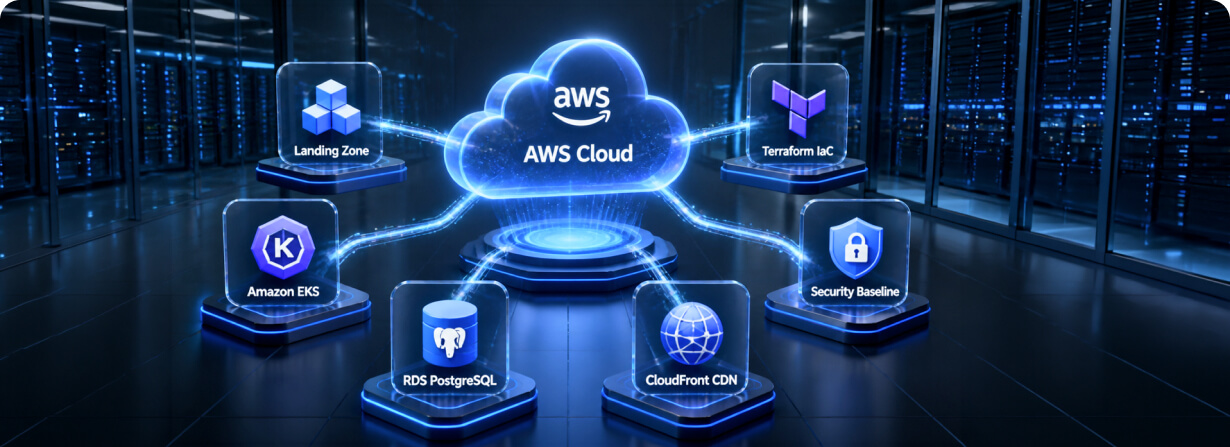
Designed AWS architecture for a Series A SaaS startup — multi-account landing zone, EKS cluster, RDS PostgreSQL, CloudFront CDN, and Terraform IaC — with a security baseline from day one.
Outcome:
Production-ready AWS environment in four weeks; security audit passed at SOC 2 Type I assessment six months later; infrastructure costs 34% below comparable manually provisioned environments.
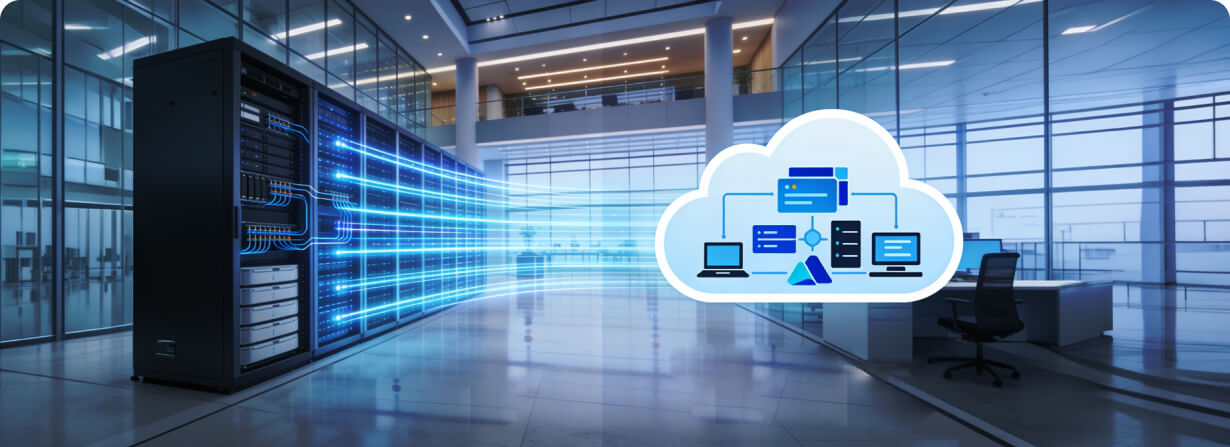
Migrated a 200-VM on-premise estate to Azure for a professional services firm — 18-month lift-and-refactor programme with phased cutover, zero production incidents, and cloud-native refactoring for tier-1 workloads.
Outcome:
Annual infrastructure cost reduced by 28% versus on-premise; deployment frequency increased from monthly to weekly; disaster recovery RTO reduced from 72 hours to 4 hours.
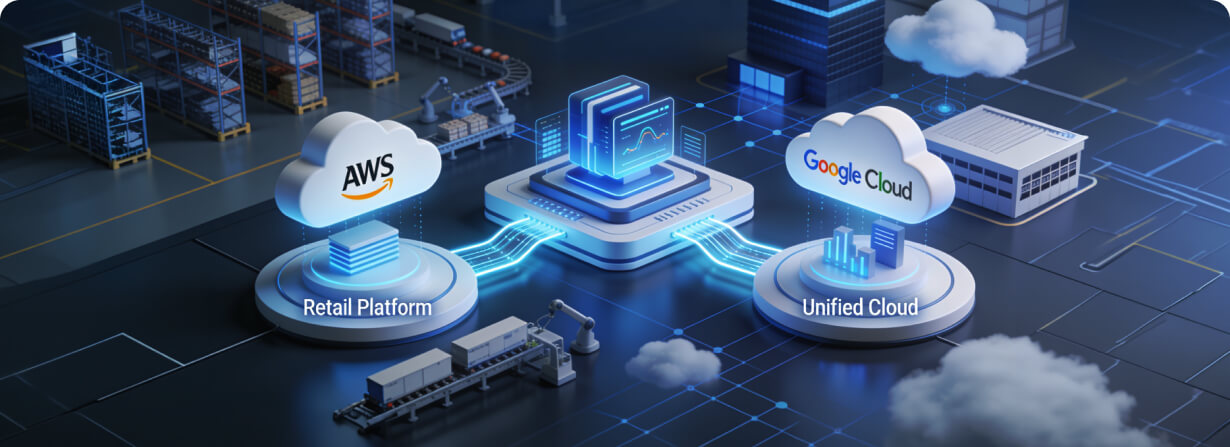
Designed deliberate multi-cloud architecture for a national retailer — AWS for core e-commerce and fulfilment, GCP for ML and analytics workloads — with unified identity, observability, and cost governance across both clouds.
Outcome:
ML model training costs reduced 41% by moving to GCP Vertex AI; e-commerce platform availability improved to 99.98%; cost visibility across both clouds delivered within first month.
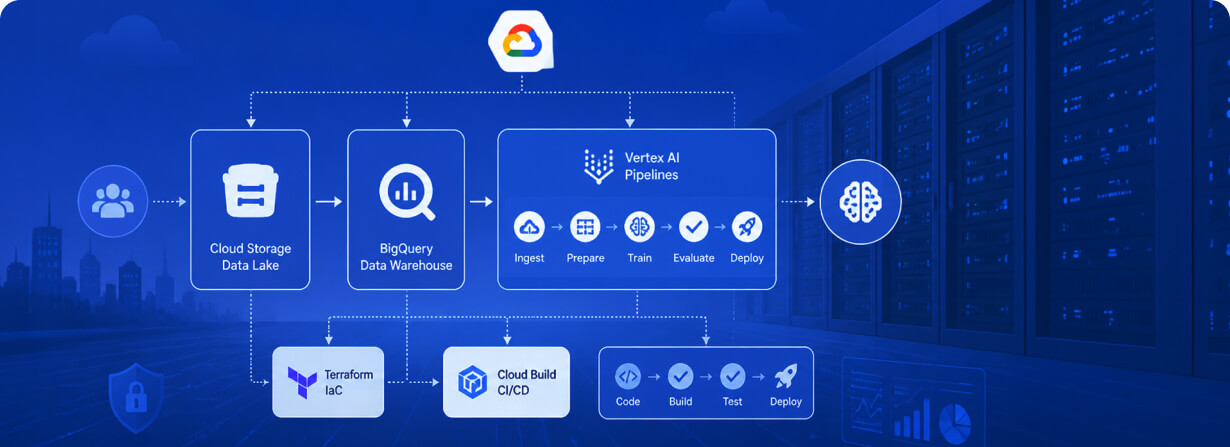
Built GCP data and ML infrastructure for an AI product company — Vertex AI pipelines, BigQuery data warehouse, GCS data lake, and Terraform IaC with CI/CD for model deployment.
Outcome:
49%
increase in appointment adherence; patient satisfaction score increased by 22 points.Model training time reduced by 60% using managed Vertex AI; data team infrastructure costs reduced 35% through autoscaling and preemptible VMs; full audit trail for model provenance established.















Our cloud architecture services are built around workload fit, not vendor preference. AWS consulting service is often the right call for teams that need breadth of managed services and global infrastructure. Azure consulting services make more sense when your organization is deep in the Microsoft ecosystem — Active Directory, Office 365, or .NET workloads. GCP is often the best choice for data-intensive or AI/ML workloads. We model the trade-offs for your specific situation and recommend accordingly, with a documented rationale you can take to your board.
A cloud landing zone is the foundational environment you build before any workloads migrate: account structure, networking topology, identity federation, security guardrails, and governance policies. Think of it as pouring the concrete before raising the walls. Without one, teams end up with sprawling accounts, inconsistent security configurations, and cost visibility problems that are expensive to fix later.
Lift-and-shift is the starting point for some workloads, but it's rarely the whole story. Our cloud migration services begin with an assessment of your estate, applications, dependencies, data, and compliance requirements, then assign each workload a migration strategy: rehost, replatform, refactor, or retire. Some workloads move quickly; others need to be rebuilt to get any benefit from the cloud. We prioritize by business impact and risk, and migrate in waves so you're never betting the entire estate on a single cutover.
For most organizations, a multi-cloud strategy is not a starting point. It's something you grow into. Running workloads across two or more providers adds significant operational complexity: separate security controls, different billing models, and teams that require deep expertise across multiple platforms. That said, multi-cloud makes clear sense when different workloads have genuinely different requirements, when data residency regulations demand it, or when avoiding vendor lock-in is a strategic priority. We help you make the case for or against it based on your specific situation, not on what's fashionable.
It starts with a discovery and architecture review, assessing your current environment, defining target architecture, and scoping the migration or build-out. From there, our AWS consulting services or Azure consulting services team builds the landing zone, migrates workloads in defined waves with rollback plans at each stage, and closes with a knowledge transfer so your team can operate the environment independently. Architecture documentation, runbooks, and a post-migration optimization review are included as standard, not add-ons.


Since 1999, SunTec has been a trusted business process and software engineering partner for technology companies worldwide. Our team of over 1,500 full-time employees delivers innovative services every day to help our clients save time and money.


