When cloud spend is a single line item in the monthly bill, no engineering team feels responsible for it. Without cloud cost management by team, product, and environment, there is no accountability, no optimization incentive, and no early warning when a service starts burning money.
Non-production environments with no automated shutdown schedules are one of the most reliable sources of cloud waste. A staging environment that runs 168 hours a week when it needs only 40 is a waste of that environment's entire cost.
Reserved instances and savings plans purchased without a rightsizing baseline lock spend into configurations that don't match actual usage patterns. Organizations routinely leave 20-40% of their reserved capacity commitments unrealized due to poor planning and a lack of ongoing cloud cost management.
When cloud costs are managed by a central finance or IT function with no engineering involvement, the teams that make architectural decisions have no feedback loop. FinOps is, hence, a cultural and organizational framework, not just a tooling problem.
Establish a culture of financial accountability by aligning engineering velocity with business value. We design a custom roadmap that moves cloud cost management from a monthly report to a core engineering discipline.
Eliminate the "black box" of cloud billing by giving every team real-time visibility into their spend. We build automated dashboards and reporting structures that clearly link cloud consumption to specific products and environments.
Maximize operational efficiency by minimizing cloud waste and aligning resource consumption with actual demand. We implement AI-powered optimization strategies that reduce your monthly spend without compromising system performance or reliability.
Establish sustainable spending habits by embedding financial guardrails directly into your technical operations. We move cloud cost management out of spreadsheets and into the development lifecycle, ensuring every architectural decision is financially informed and governed.
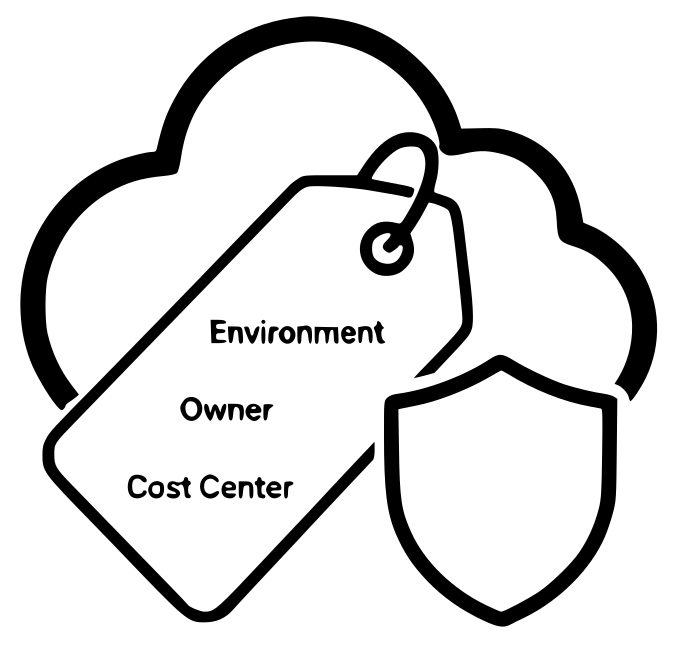
Every visibility project includes automated tagging policies. We deploy remediation tools to ensure your cost data is accurate and attributable across all accounts.
We establish rightsizing baselines before recommending financial commitments. This ensures you never lock in spend for over-provisioned or idle resources.
Cost management is integrated into the development lifecycle. We shift cost-visibility into CI/CD pipelines so engineers understand financial impacts before production.
Waste elimination and governance are fundamental standards. We ensure every environment is financially governed, secure, and optimized by default.
Start with a Cloud Cost Audit — Full cost analysis, waste quantification, and optimization roadmap delivered.
We analyze your cloud spend to identify top costs, untagged resources, and wasted budget. You receive a prioritized report of optimization opportunities and a custom governance design before implementation begins.
We deploy automated tagging to ensure every dollar spent is attributable. Custom dashboards and showback reports are launched, providing your engineering teams with real-time budget alerts and anomaly detection.
We automate environment scheduling and implement rightsizing for your primary workloads. After securing savings through reserved instances, we integrate cost-tracking into your CI/CD pipelines to prevent future waste.
We embed a permanent cost-review process and budget ownership within your engineering workflows. Your team will be trained on the new dashboards and provided with a comprehensive cloud cost governance playbook.

Conducted a FinOps audit for a Series B SaaS company whose AWS bill had grown 150% in 12 months without corresponding revenue growth — tagging framework, rightsizing, dev environment scheduling, and reserved instance planning implemented over eight weeks.
Outcome:
AWS monthly spend reduced by 40% within 90 days; dev environment costs reduced 68% through automated overnight and weekend shutdown; engineering teams given real-time cost dashboards for the first time.

Designed and implemented a showback framework for an enterprise with 12 business units sharing a multi-account AWS and Azure estate — unified tagging taxonomy, monthly showback reports, and budget ownership by BU.
Outcome:
First accurate cost attribution by business unit achieved; cloud cost growth rate reduced from 35% to 8% quarter-on-quarter as teams became accountable; three business units identified and consolidated underutilized reserved capacity.

Automated non-production environment lifecycle management for a 200-person engineering organization — automated start/stop scheduling, instance hibernation, and environment self-service with cost guardrails.
Outcome:
Non-production environment costs reduced by 61%; total cloud waste from idle environments eliminated within the first month; engineering teams retained full self-service capability with guardrails instead of restrictions.

Conducted rightsizing baseline and reserved instance purchase planning for a fintech with a $2M+ annual AWS commitment — usage analysis, coverage modeling, and phased purchase recommendation across EC2, RDS, and ElastiCache.
Outcome:
Annual cloud commitment cost reduced by $480K through optimized reserved instance portfolio; reserved instance utilization rate improved from 61% to 94%; unused commitments eliminated through a structured exchange program.






















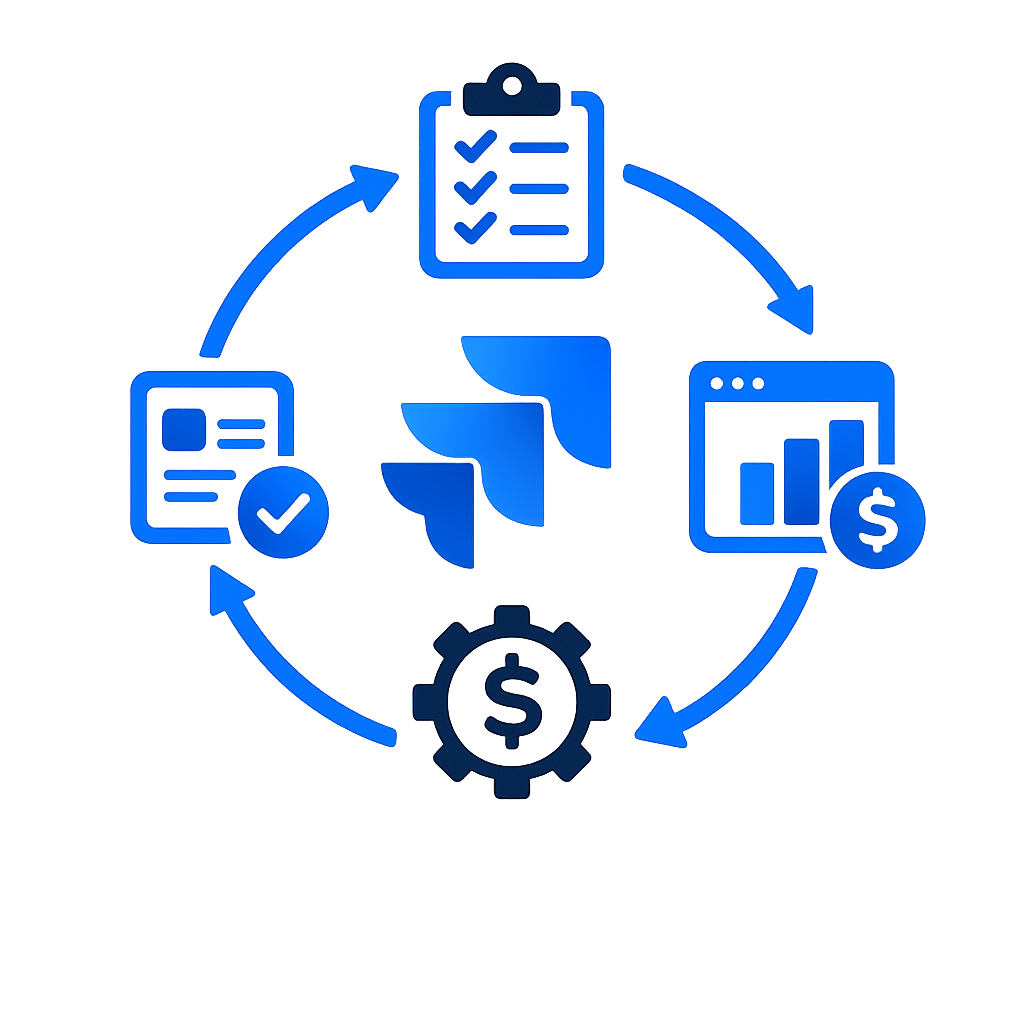
Cloud cost management is the practice of tracking and reducing what you spend on cloud infrastructure. FinOps goes further; it is a cultural and operational framework that brings engineering, finance, and product teams into shared accountability for cloud spend. Where cloud cost management tells you what you're spending, FinOps builds the visibility, governance, and team behaviors to ensure every dollar spent maps to business value. Most organizations start with cost management and graduate to FinOps as they scale.
According to industry benchmarks, organizations typically find that 20–30% of their cloud spend is recoverable waste (idle resources, oversized instances, and non-production environments running around the clock). Our cloud cost optimization engagements begin with an audit that quantifies your specific opportunity within the first few weeks. Quick wins like rightsizing and dev environment scheduling often deliver savings within a month. Longer-term initiatives, such as reserved capacity planning and tagging governance, take longer to fully operationalize but produce compounding savings over time.
Neither extreme is usually the right answer. Our FinOps consulting model is built around developing your team's capability, not creating a dependency on us. We design dashboards, tagging frameworks, and governance processes that enable your engineers and finance stakeholders to operate independently. For organizations not ready to build an internal function yet, we also offer a retainer model where we run ongoing cloud cost management reviews, anomaly alerting, and commitment management on your behalf, with a clear handoff plan built in from the start.
Yes. Our FinOps consulting service is cloud-neutral by design. In multi-cloud environments, cost visibility problems tend to be worse because billing data across providers is formatted differently, tagged inconsistently, and almost never rolled up into a single view. We normalize cost data across all three providers, apply a consistent tagging taxonomy, and build unified dashboards that give your teams one source of truth regardless of which cloud a workload runs on.
It's the most common starting point. Most organizations that engage our cloud cost management services begin with a bill they can't fully explain; they know it's too high, but not where the waste is or who owns it. The cost audit is specifically designed for this situation: we ingest your billing data, map it to teams, products, and environments, and surface the specific line items driving spend. You'll leave the audit with a clear breakdown, a prioritized list of optimization opportunities, and enough visibility to make your next architecture decision with cost as a first-class input.


Since 1999, SunTec has been a trusted business process and software engineering partner for technology companies worldwide. Our team of over 1,500 full-time employees delivers innovative services every day to help our clients save time and money.


