When analysts spend most of their time cleaning and validating data before they can use it, the infrastructure is the problem, not the team. Bad data pipelines produce confidently wrong decisions.
Proof-of-concept models that look great in a notebook often underperform in production because data drift, latency requirements, and integration complexity were not designed in from the start.
Weekly reports about what happened last month are not competitive intelligence. Businesses that win on data have real-time or near-real-time signals feeding operational decisions, not just board decks.
When data science outputs are not connected to business workflows, the work sits in dashboards nobody checks. The integration layer between insight and action is where most data ROI is lost.
Our data engineering services cover the full stack. That includes data engineering for reliable pipelines and governed warehouses.
It also covers machine learning for models that perform in production, and predictive analytics that deliver actionable signals to the systems that need them.
We architect batch and streaming data pipelines built for reliability and observability, as well as data warehouse and lakehouse designs across Snowflake, BigQuery, and Databricks. Real-time infrastructure runs on Kafka, Flink, and event-driven architectures for operational data, while legacy ETL pipelines get modernized into dbt-based transformation layers. Data quality and governance, including validation, lineage tracking, and access control, are built in from the start, not bolted on after.
Build custom models across classification, regression, NLP, computer vision, and recommendation systems, with full MLOps built in: versioning, monitoring, and retraining pipelines from day one, not a one-time handoff. Generative AI integration encompasses LLM fine-tuning, RAG systems, and AI feature development, backed by a centralized feature store to ensure consistent model inputs across teams. Every model ships with evaluation and bias auditing against production benchmarks and responsible AI standards.
We build forecasting models for demand and revenue using historical data and external signals, as well as churn prediction and retention scoring, integrated directly into CRM and marketing workflows. Anomaly detection is implemented to flag operational, financial, and security issues in real time. We also modernize static reporting into interactive, self-serve analytics, so business users get answers without waiting on an analyst.
Custom ML models and retrieval-augmented generation (RAG) pipelines, built on fine-tuned models and domain-specific knowledge bases so outputs stay grounded in your business context. Every model ships with structured evaluation, prompt testing, and guardrails, plus hallucination mitigation and PII protection for regulated use cases. Deployment includes monitoring and retraining, not a one-time release.
We assess your current data infrastructure, source systems, quality issues, and governance gaps. Output: a prioritized data roadmap with build-versus-buy recommendations and ROI estimates per initiative.
Data pipelines, warehouse design, and quality frameworks are established. This is the layer everything else depends on, so we build it once and build it right.
ML models are developed, evaluated against production-representative data, and validated against defined business metrics. No model ships without a performance baseline agreed upon upfront.
Models and analytics are integrated into the business workflows where they create value. Teams are trained on interpretation and maintenance. Monitoring dashboards go live from day one.
These patterns reflect representative engagements across retail, financial services, SaaS, and logistics. Outcomes are illustrative and depend on data quality, scale, and integration readiness.
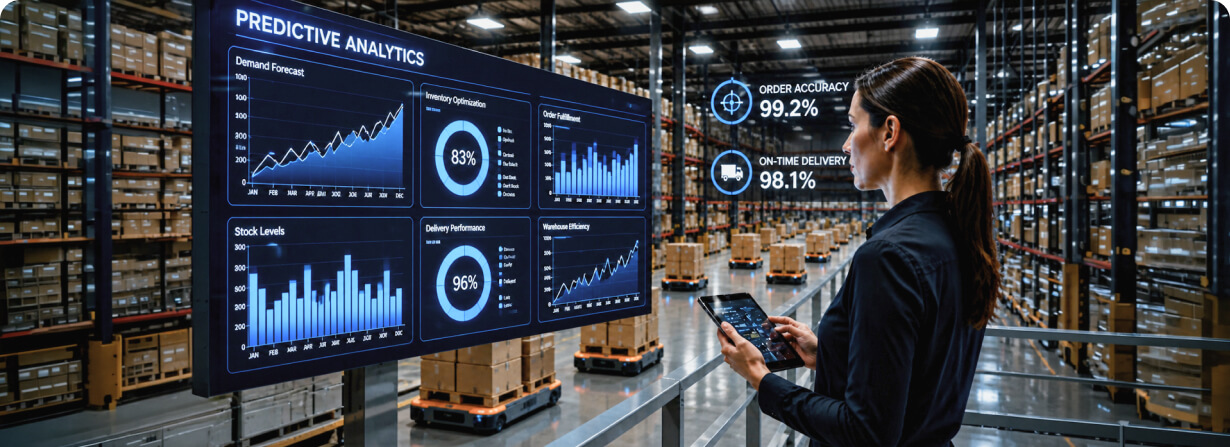
Built a demand forecasting system for a national retailer across a deep SKU catalog and many locations. Integrated POS, weather, events, and promotional data.
Outcome:
meaningful reduction in stockouts and overstock write-offs, with significant improvement in forecast accuracy.

Deployed a real-time anomaly detection model on a high-volume transaction stream, with low-latency scoring integrated into the authorization pipeline.
Outcome:
substantial reduction in fraud losses and lower false-positive rate compared to a rules-based system.

Built a customer health scoring model for a B2B SaaS platform, integrating product usage, support tickets, billing, and NPS data into a single churn risk score.
Outcome:
improvement in at-risk customer retention and stronger customer success productivity.
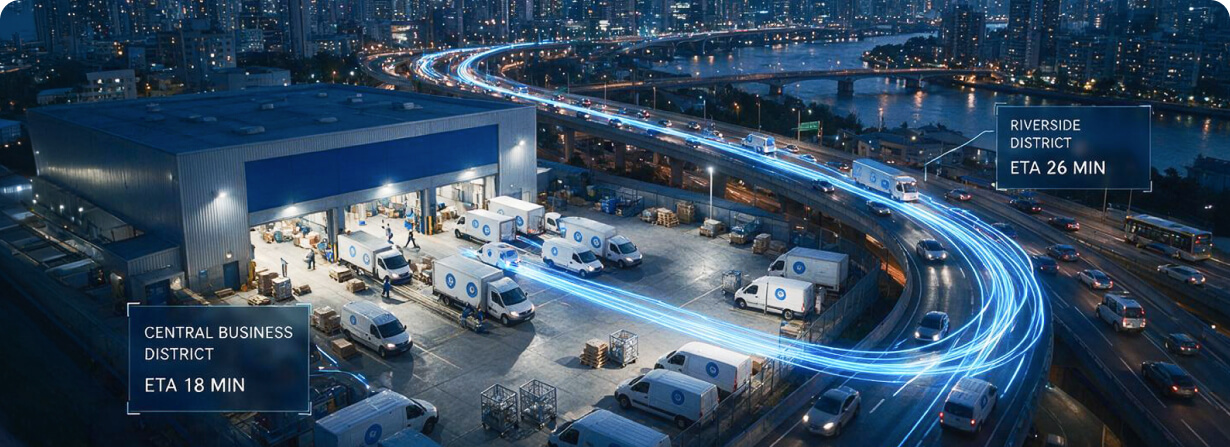
Developed predictive ETA and dynamic routing models for a high-volume last-mile delivery operation.
Outcome:
meaningful reduction in fuel costs and improvement in on-time delivery rate across the route network.
We recommend tools based on your scale, team capability, and cost profile. The goal is the right stack for your business, not a fixed reference architecture.
Our data engineering services focus on building the central nervous system of your organization. We design and implement reliable batch and streaming pipelines, architect data warehouses across Snowflake, BigQuery, and Databricks, and establish data quality frameworks. The goal is a governed, trusted, and accessible data layer so your team spends time on analysis rather than data cleaning.
Unlike static reporting, our predictive analytics services provide forward-looking signals you can act on in real time. We build custom models for demand forecasting, churn prediction, and anomaly detection. By integrating these insights directly into operational workflows like your CRM or ERP, we turn historical data into a tool for proactive decision-making.
Most AI projects fail because they are not designed for the real world. Our machine learning development services are MLOps-first. We do not just hand over a notebook; we build the training, versioning, and monitoring pipelines required to handle data drift and latency at scale. Your models perform reliably in production, not just in a demo environment.
We are platform-agnostic and avoid vendor lock-in. Our data and AI services are designed to integrate seamlessly with your current infrastructure across AWS, GCP, or Azure. We use modern tools like dbt, Airflow, and MLflow to ensure new data capabilities complement your existing software ecosystem without requiring a total overhaul.
We prioritize velocity-to-value across the engagement. Our methodology moves from a Data Architecture Audit to the first measurable output inside a structured rollout window. By building production-grade layers from day one, the foundation laid in the early weeks directly supports the machine learning models deployed in the next phase.
Yes. Generative AI is part of our standard practice across LLM integration, RAG systems, and fine-tuning. Equally important, we apply the same MLOps and governance discipline to GenAI work as we do to classical ML. That includes evaluation harnesses, hallucination monitoring, prompt versioning, and clear human-in-the-loop controls for high-impact decisions.


Since 1999, SunTec has been a trusted business process and software engineering partner for technology companies worldwide. Our team of over 1,500 full-time employees delivers innovative services every day to help our clients save time and money.


