Copy-paste deployment steps, environment-specific manual configuration, and undocumented pre-flight checks are the primary sources of deployment-caused incidents. In such cases, deployment automation doesn't just save time; it minimizes an entire class of failure modes.
When staging diverges from production in configuration, secrets, Infrastructure as Code versions, or dependency versions, staging tests stop predicting production behavior. Environment parity is an architectural decision that must be enforced by the Mobile CI/CD pipeline, not by convention.
Test suites that take 40 minutes, pipeline queues that block deployment for hours, and post-deploy monitoring that requires manual log trawling all extend the feedback loop between writing code and knowing it works. Every hour of feedback loop delay costs engineering velocity.
Environment-specific configuration managed outside version control (in shared wikis, Slack messages, or tribal knowledge) creates drift that causes deployment failures and security vulnerabilities. Secrets management and configuration-as-code embedded in a Mobile CI/CD pipeline can solve this.
Modernize your engineering culture with a clear roadmap for automation and operational excellence. We assess your current delivery speed and architectural readiness to build a tailored integration strategy that aligns your people, processes, and technology.
Eliminate manual provisioning and configuration drift by treating your infrastructure as software with our deployment automation service. We build programmable cloud environments (AWS, Azure, and GCP) that are version-controlled, repeatable, and can scale instantly to meet demand without increasing headcount.
Replace slow, manual releases with hardened Mobile CI/CD pipelines that move code from commit to production with absolute confidence. We design automated workflows that integrate security scanning, quality gates, and multi-stage testing into a seamless deployment engine.
Decouple your services and maximize resource efficiency through expert container orchestration. We help you transition from brittle monoliths to resilient, distributed systems designed for high availability and rapid scaling.
Transform passive monitoring into proactive reliability engineering. We deploy deep-telemetry solutions that provide real-time visibility into system health, enabling your team to resolve incidents before they affect end users.
Ensure your delivery engine remains secure and optimized with proactive platform management. We act as a specialized extension of your team, handling the heavy lifting of infrastructure patches, pipeline health, and security compliance.
We integrate secrets management and encryption into every pipeline from day one. Security isn't an add-on; it is our non-negotiable starting point.
Every deployment strategy includes tested rollback procedures. We ensure your releases are predictable and your system uptime is protected against failed commits.
We deliver comprehensive pipeline documentation and runbooks with every hand-off. Your team gains full ownership without the burden of knowledge silos.
By using standardized IaC frameworks, we eliminate configuration drift. Your environments remain identical, auditable, and easy to scale.
Mobile CI/CD pipeline design and automation delivered for SaaS products, mobile apps, data platforms, and microservices architectures across GitHub Actions, GitLab CI, and ArgoCD.
Start with a Pipeline Audit — Full delivery pipeline assessment, incident analysis, and architecture recommendation with DORA baseline delivered. No obligation to continue.
We inventory your current processes, analyze how often you deploy, and identify engineering bottlenecks. You get a clear roadmap and a recommended architecture for your new pipeline, ensuring we are fully aligned before any work starts.
We build your core CI pipeline to handle building, testing, and security scanning with speed and efficiency. This phase secures your data with integrated secrets management and uses Terraform to ensure your environments are identical and stable.
We automate your move to production with built-in safety gates and testing. This includes setting up smart release strategies, like blue-green or canary deployments, and automated rollbacks to keep your systems online if an error occurs.
We add high-level features like feature flags, GitOps for Kubernetes, and real-time dashboards to track performance. Finally, we train your team and hand over all documentation and runbooks so you have full control.
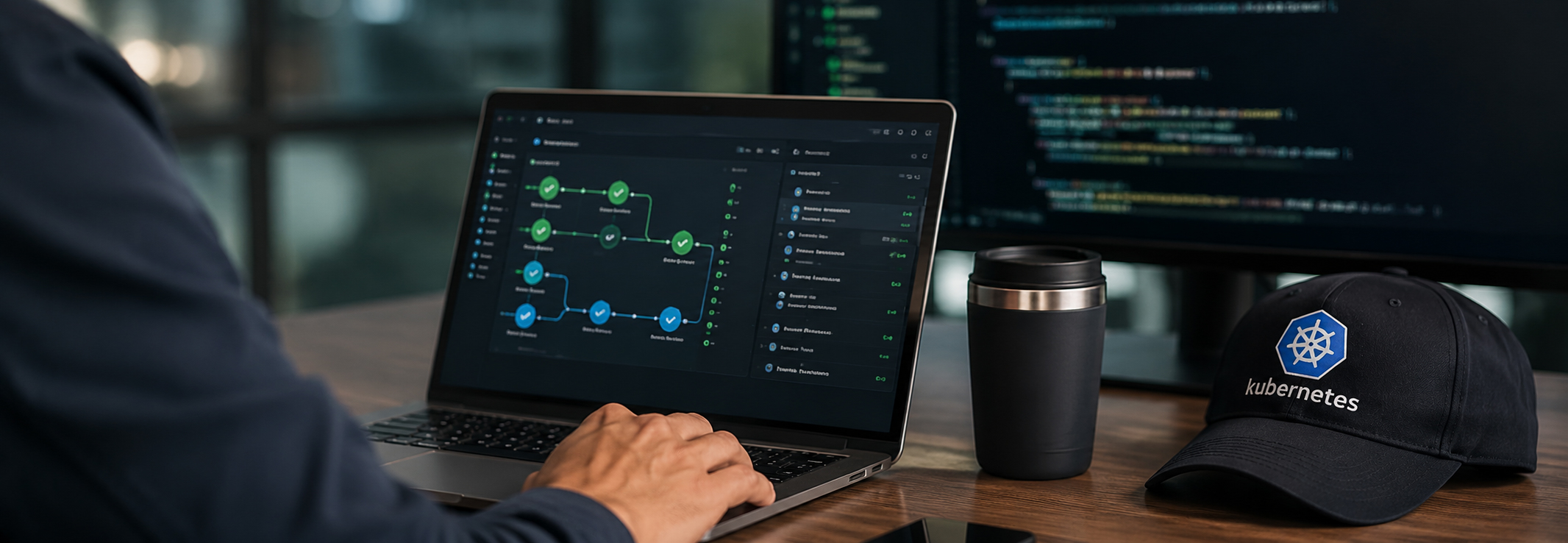
Redesigned Mobile CI/CD pipeline for a B2B SaaS platform on GitHub Actions — parallelized test suite, blue-green deployment to EKS, automated rollback, and DORA metric tracking from day one.
Outcome:
Deployment frequency increased from weekly to 8 deploys per day; lead time from commit to production reduced from 3 days to 42 minutes; deployment failure rate reduced from 12% to under 2%.
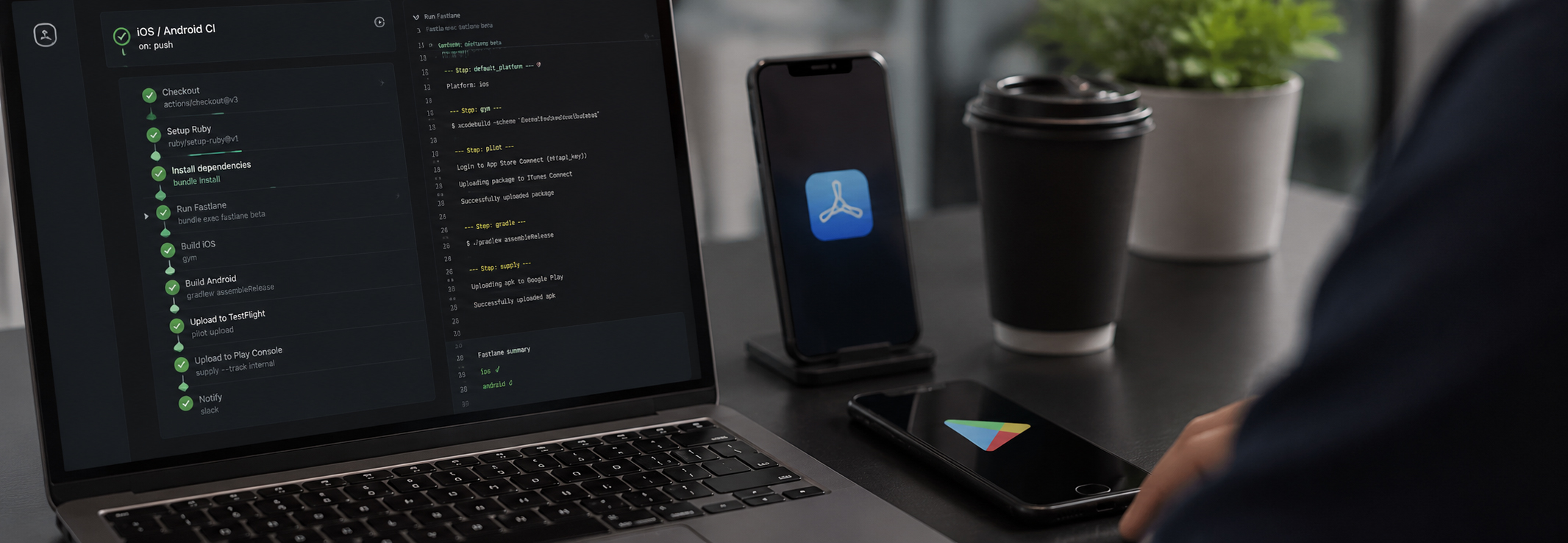
Built end-to-end Mobile CI/CD pipeline for iOS and Android apps using Fastlane and GitHub Actions — automated builds, TestFlight and Play Store internal track distribution, and App Store submission on tagged releases.
Outcome:
App store submission time reduced from 4 hours of manual steps to 12 minutes; QA test coverage increased 3x through automated device farm integration; release cadence increased from monthly to bi-weekly.
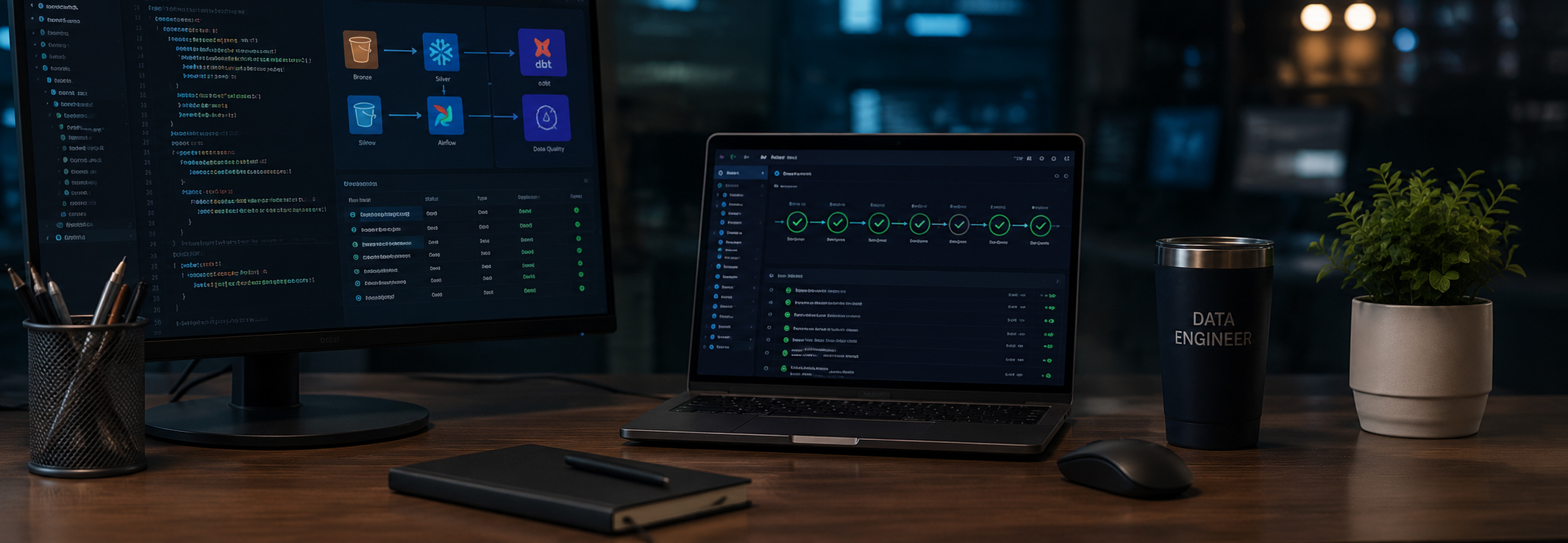
Implemented Mobile CI/CD pipeline for a data platform — automated dbt model testing, staging environment promotion, Airflow DAG deployment via GitOps, and automated data quality validation gates before production promotion.
Outcome:
Data pipeline deployment time reduced from 2 hours of manual steps to 8 minutes; data quality regressions caught in CI before reaching production; data team deployment confidence significantly improved.

Designed ArgoCD-based GitOps platform for a 30-service microservices architecture — automated canary deployments, drift detection, self-healing reconciliation, and audit trail for all production changes.
Outcome:
Production incidents caused by configuration drift eliminated; deployment rollback time reduced from 45 minutes to 90 seconds; SOC 2 audit trail for all infrastructure changes delivered automatically.


















Having a Mobile CI/CD pipeline and having a well-engineered one are different things. Most teams inherit a Mobile CI/CD pipeline that was bolted together under deadline pressure — slow build times, brittle test stages, secrets stored in environment variables, and deployment steps that only one engineer fully understands. Our Mobile CI/CD services focus on taking what you have, auditing where it breaks down, and rebuilding it to a production standard — with parallelized stages, proper secrets management, environment parity, and failure triage that doesn't require waking someone up at 2 am.
We don't. Our DevOps pipeline automation practice is tool-agnostic. We recommend based on your stack, team size, and where your code lives. If you're already on GitHub, GitHub Actions services are typically the path of least friction; native to your repository, a large library of reusable actions, and straightforward YAML configuration. If you're on GitLab, Azure DevOps, or running Jenkins on-premise, we work with those, too.
Blue-green deployment runs two identical production environments simultaneously: one live, one idle. You deploy your new version to the idle environment, validate it, then switch traffic over instantly. If something goes wrong, you flip back in seconds with no redeployment. It's the right choice when you need zero-downtime releases and fast rollback. Canary releases are better when you want to gradually expose a new version to a percentage of users first. Rolling deployments suit teams with a higher risk tolerance but less infrastructure overhead. We recommend a strategy tailored to your application's risk profile and release frequency, not a one-size-fits-all approach.
A focused deployment automation engagement, covering pipeline audit, rebuild, secrets management, deployment strategy, and integration with your monitoring stack, typically runs 3 to 5 weeks, depending on application complexity and the number of environments in scope. Multi-service architectures or those with regulated deployment approval workflows take longer to get right. Either way, you'll have working quality gates and automated deployments before the engagement closes, not a roadmap for later.
Yes, that's an explicit requirement for how we build. Every Mobile CI/CD pipeline we deliver comes with pipeline-as-code stored in your repository, full documentation covering stage logic, environment configuration, and failure runbooks, and a handover session with your engineers. We use standard, readable YAML and well-supported tools so your team can modify stages, add services, and debug failures independently. The measure of a good Mobile CI/CD service engagement isn't whether the pipeline works when we hand it over; it's whether your team is still running it confidently six months later.


Since 1999, SunTec has been a trusted business process and software engineering partner for technology companies worldwide. Our team of over 1,500 full-time employees delivers innovative services every day to help our clients save time and money.


