Bad labels produce poorly generalizing models, and the damage is invisible until production:
Annotation initiatives are often evaluated on speed and cost rather than correctness. Without predefined quality benchmarks, teams only recognize inconsistencies after the model starts producing unreliable outputs.
Specialized datasets require specialized knowledge. When domain-specific data, such as medical images, legal documents, or technical text, is annotated by generalists, the errors are consistent and deeply embedded.
As projects evolve, label definitions and taxonomies often shift. In the absence of proper version control and structured schema management, these changes introduce inconsistencies across the dataset.
Annotation workflows tend to prioritize high-volume, straightforward data points to maintain efficiency. This leads to datasets that are heavily skewed toward common scenarios, while rare but critical edge cases remain underrepresented.
We treat annotation as a structured data engineering problem, integrating schema design, sampling strategy, QA pipelines, and validation workflows.
Every annotation engagement starts with schema design, quality metric definition, and sampler strategy before a single label is applied. We run multi-round quality reviews with inter-annotator agreement scoring and deliver datasets with accuracy validation reports.
Power visual AI models with high-precision labeling for complex spatial tasks. We provide the ground-truth data necessary to train robust models for object recognition, autonomous navigation, and predictive maintenance.
Refine your Large Language Models and NLP pipelines with high-quality linguistic datasets. We specialize in capturing the nuance of human language to improve intent recognition, sentiment accuracy, and model alignment.
Develop multimodal AI models that understand speech, sound, and cross-media contexts. Our services bridge the gap between different data modalities to create seamless, multi-sensory AI experiences.
Ensure dataset integrity through a rigorous, multi-layered validation process. We move beyond simple data labeling by implementing statistical scoring and expert reviews to guarantee model-ready accuracy.
We bridge the gap between raw data and production-ready models with high-fidelity, expert-led labeling. Our AI data training infrastructure is built to handle the edge cases and nuances that generic labeling services miss, ensuring your training data is a competitive advantage, not a bottleneck.
Every dataset we deliver comes with an accuracy validation report. If the inter-annotator agreement doesn't meet the agreed-upon threshold, we reannotate before delivery.
Label taxonomy, annotation guidelines, edge case definitions, and quality thresholds are defined with your ML team. We create gold-standard labels for annotator training and ongoing quality measurement.
Domain-appropriate annotators selected and trained on your schema. Pilot batch of 500–1,000 samples annotated and IAA scored. Annotators below the threshold are replaced before the full program begins.
Full annotation program with multi-round review, continuous IAA monitoring, and daily progress reporting. We deliberately injected edge case samples to ensure model coverage.
Final accuracy validation against the gold standard. Our team delivers a per-class accuracy report, a confusion matrix, and an edge-case coverage analysis for each dataset batch.
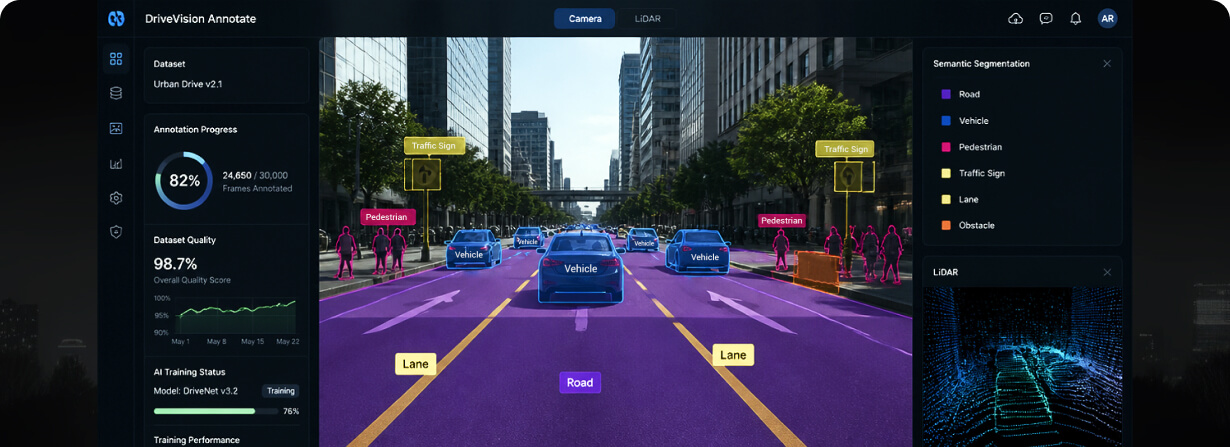
Multi-class semantic segmentation annotation for a self-driving system. This includes labeling roads, vehicles, pedestrians, and obstacles across 2.4M image frames with LiDAR co-annotation.
Outcome:
IAA score of 0.94 Kappa; model mIoU improved from 71% to 84% after retraining on the annotated dataset.

Radiologist-annotated chest X-ray dataset for a pneumonia detection model. It includes bounding-box and severity-classification annotations, with clinical review at every QA round.
Outcome:
Model AUC improved from 0.81 to 0.93 after training on clinician-annotated vs. general-annotator dataset.

Multi-label product classification and attribute extraction annotation across 850,000 SKUs for a marketplace, including brand, category, color, material, and condition labeling.
Outcome:
Automated product classification accuracy improved from 73% to 91%; manual classification team workload reduced by 67%.

Multi-intent and entity annotation for a customer support NLP system. We delivered 180 intent classes across 500,000 conversation turns with specialist annotators trained on domain terminology.
Outcome:
Model intent accuracy of 89% on held-out test set; out-of-scope intent detection rate improved to 94%.















The difference between an annotation that works and an annotation that wastes your training budget is quality measurement. We will prove it with a pilot batch before you commit to volume.
We define quality benchmarks upfront, including inter-annotator agreement thresholds, gold standard validation, and multi-round QA workflows. Each dataset is delivered with validation reports to ensure consistency across all labeled data.
Our image annotation services focus on structured workflows, including schema design, edge case sampling, and validation metrics. We support bounding boxes, segmentation, keypoints, and classification with strict quality controls.
We use inter-annotator agreement metrics such as Cohen’s Kappa and Fleiss’ Kappa, along with gold dataset validation and per-class agreement analysis. Quality is measured continuously, not just at the final stage.
Yes. We can work within your existing annotation infrastructure or deploy our own tools. Our quality control and validation workflows remain consistent across platforms.
We design deliberate sampling strategies to identify and include rare but critical edge cases. This ensures models perform reliably not just on common scenarios but also in high-impact, real-world conditions.
Yes. We start with a pilot batch where we annotate a representative dataset, measure quality metrics, and share validation reports. This allows you to evaluate our data annotation services before scaling.
We follow strict schema versioning and change control processes. Any updates are tracked, documented, and, if required, applied retroactively to maintain dataset consistency.
We support industries such as healthcare, autonomous systems, retail/eCommerce, finance, and customer support AI, where high-quality labeled data is essential for model performance.


Since 1999, SunTec has been a trusted business process and software engineering partner for technology companies worldwide. Our team of over 1,500 full-time employees delivers innovative services every day to help our clients save time and money.


