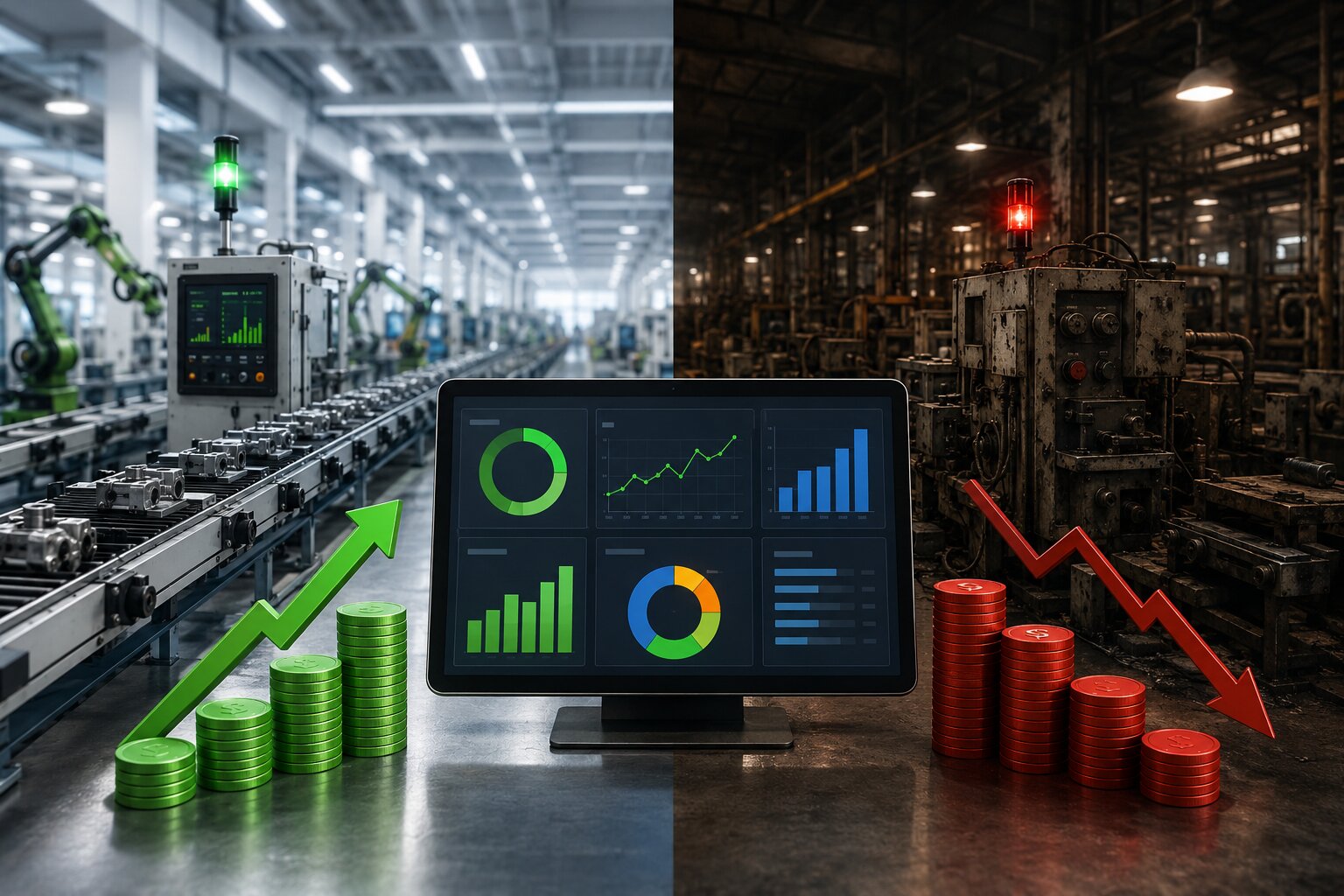
A single unplanned line stoppage at a high-throughput facility can cost $250,000 per hour. A 5% improvement in demand forecast accuracy can reduce safety stock requirements by 20% across a distribution network. A real-time AI supply chain visibility platform can reduce carrier dispute resolution time from days to hours.
The data to drive these outcomes exists in most manufacturing and logistics operations; it is the capability to act on it that is missing.
Our manufacturing and logistics-focused digital engineering practice bridges the gap between operational technology (OT) and information technology (IT); ingesting sensor, ERP, WMS, and TMS data into AI and analytics systems for actionable operational intelligence.
Sensor data ingestion, anomaly detection, and failure prediction models for critical manufacturing equipment and fleet assets.
ML-driven SKU and regional demand forecasting incorporating seasonality, promotions, market signals, and external data.
End-to-end shipment tracking, milestone exception alerting, and carrier performance analytics across the supply chain.
Pick-path optimization, slotting intelligence, labor productivity analytics, and inbound/outbound flow optimization with secure warehouse management system integration.
Computer vision-based defect detection on production lines, reducing manual inspection bottlenecks and human error rates.
Spend analytics, supplier risk scoring, contract compliance monitoring, and sourcing optimization.
High-speed visual inspection powered by deep learning to identify surface anomalies, dimensional inaccuracies, and assembly errors in real-time, ensuring zero-defect delivery at line speed.
Automated categorization and multidimensional visualization of historical spend data to identify leakage, consolidate fragmented suppliers, and uncover hidden cost-saving opportunities across the enterprise.
Predictive forecasting models that synthesize historical sales, market signals, and seasonal trends to optimize inventory levels and minimize the impact of supply chain volatility.
OPC-UA, MQTT, Modbus, and proprietary industrial protocols are normalized into a unified data stream.
Local inference at the machine level for latency-sensitive quality-control and real-time anomaly-detection use cases.
OSIsoft PI and similar historians are connected to cloud data platforms for historical analysis and model training.
DMZ and network segmentation patterns that enable data flow without exposing OT networks to IT security risks.
Predictive maintenance platform for a tier-1 automotive parts manufacturer — monitoring 320 CNC machines.
Demand forecasting model replacing spreadsheet-based planning for a 14-DC distribution network.
Supply chain visibility platform eliminating manual carrier check-ins for a 3PL with 200+ carrier partners.
Computer vision quality control system on a PCB assembly line — replacing 6 manual inspection stations.
Predictive maintenance AI continuously ingests sensor data (vibration, temperature, pressure, acoustics) from production equipment and applies anomaly detection and failure-prediction models to flag degradation before it becomes a breakdown. Unlike time-based preventive schedules, these models learn the specific failure signatures of each machine, enabling maintenance teams to intervene precisely when needed. Clients typically see 40–50% reductions in unplanned downtime within the first few months of deployment.
Our AI supply chain visibility platforms integrate natively with the leading ERP and WMS systems used in manufacturing and logistics, including SAP S/4HANA, Oracle ERP Cloud, Microsoft Dynamics 365, and Infor on the ERP side, and Manhattan Associates, Blue Yonder, SAP EWM, and Körber on the WMS side. We connect via standard APIs, EDI, and database connectors, and can also work with custom-built legacy systems using middleware where needed.
We use protocol bridging (OPC-UA, MQTT, and Modbus) for OT/IT integration in manufacturing AI and to extract data from PLCs, SCADA systems, and industrial sensors without disrupting live production. Data is normalized and streamed to a cloud or on-premises data platform through a secure DMZ architecture that maintains strict separation between OT and IT networks. For latency-sensitive use cases like real-time defect detection, we deploy edge computing nodes that run inference locally on the shop floor.
Demand forecast accuracy depends on the quality and depth of your historical data, but clients with 2+ years of clean transactional and inventory data typically achieve 90%+ forecast accuracy at the SKU level, compared to spreadsheet-based methods. Our models incorporate seasonality, promotional calendars, external market signals, and supplier lead times to produce forecasts that can be actioned directly by your supply planning team.
Standard deployments (predictive maintenance software, demand forecasting system, or supply chain visibility platform) typically complete in a few weeks from kickoff to production go-live. This includes data integration, model training on your historical data, UAT with your operational teams, and documentation handover. More complex multi-system implementations with significant OT/IT integration work may take a few months.
In most high-volume, repetitive inspection scenarios (PCB assembly, packaging integrity, surface defect detection), computer vision systems achieve defect-detection rates above 99%, typically exceeding manual inspection performance. However, we recommend a hybrid approach in which CV handles 95%+ of inspection volume automatically, while human inspectors focus on edge cases, model validation, and novel defect categories. This reduces inspection headcount requirements significantly while maintaining a quality oversight layer.


Since 1999, SunTec has been a trusted business process and software engineering partner for technology companies worldwide. Our team of over 1,500 full-time employees delivers innovative services every day to help our clients save time and money.


