LLM-based agents produce variable outputs, but business workflows require consistent, predictable execution. Without guardrails, validation, and defined failure modes, agents can trigger incorrect or risky actions in live systems.
Agent systems quickly move beyond simple prototypes when multiple APIs, databases, authentication layers, and error scenarios are introduced. This integration complexity is often not accounted for during initial design.
Many teams do not define structured evaluation before deployment, resulting in agents that behave unpredictably in production. Without measurable benchmarks, reliability issues are discovered only after real-world failures occur.
Multi-agent systems without clear routing logic, shared state management, and failure isolation become difficult to monitor or debug. As complexity increases, system behavior becomes opaque and operational control is lost.
Every engagement of multi-agent AI development starts with a workflow audit. We document what the agent needs to do, which tools it needs to use, what can go wrong, and the human escalation path. Our AI agent developers also build evaluation harnesses before building agent logic because the only way to know an agent is working is to measure it against something real.
We don't ship agents without evaluation harnesses. Every production agent comes with a test suite, an observability dashboard, and a documented escalation path.
The target workflow is mapped in detail to understand end-to-end execution requirements. Tool dependencies are identified, and all potential failure modes are documented. Success metrics are defined, and evaluation criteria are agreed upon before development begins.
The evaluation framework is built first to establish measurable performance benchmarks. Tool connectors are then developed and tested against real APIs. The agent skeleton is validated against the evaluation suite before any agent logic is introduced.
Agent logic, memory systems, error handling mechanisms, and human escalation paths are developed and integrated. The system is then tested in shadow mode against live environments before any production exposure is allowed.
A phased traffic rollout is executed with continuous live monitoring. Cost, latency, and task completion rates are tracked against baseline metrics. Observability dashboards are activated, and the team is trained on ongoing agent management and monitoring.
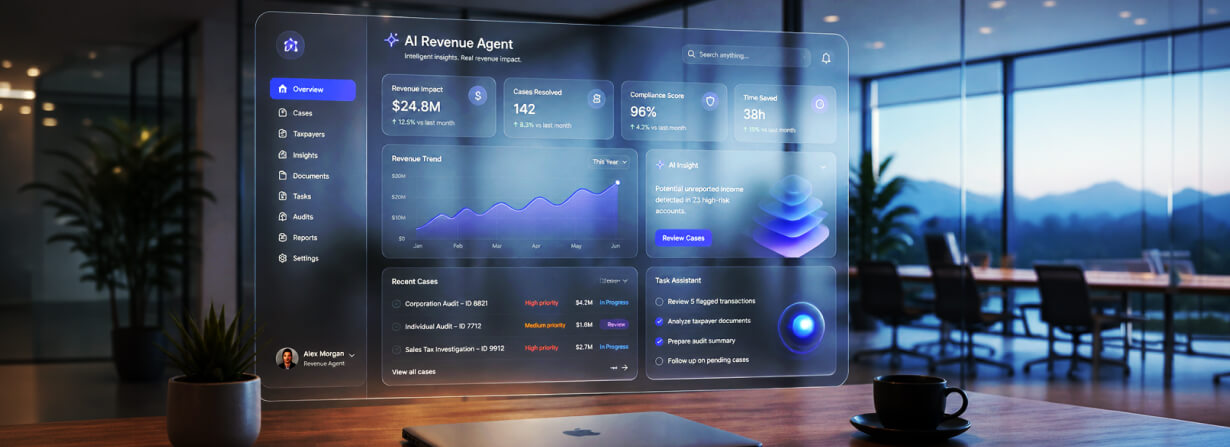
Multi-tool agent qualifying inbound leads, enriching CRM records via data provider APIs, scoring based on ICP criteria, and drafting personalized outreach for SDR review — integrated with Salesforce and email platform.
Outcome:
SDR capacity for outreach increased by 60%; lead response time reduced from 4 hours to 8 minutes.
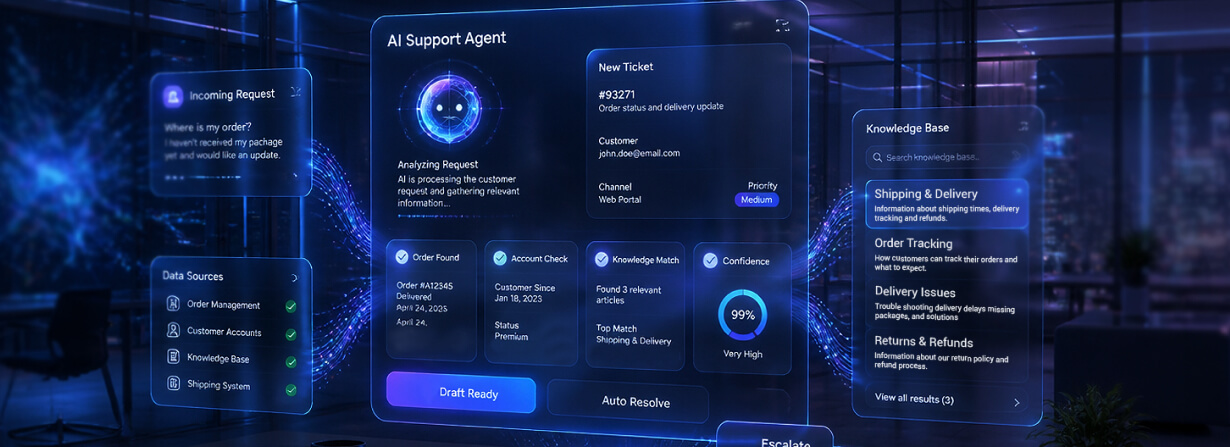
Agent resolving routine support tickets by querying order systems, account data, and knowledge base — drafting responses for human review on complex issues and auto-resolving routine queries with confidence above threshold.
Outcome:
47%
of tickets resolved without human intervention; average handle time for agent-assisted tickets reduced by 38%.
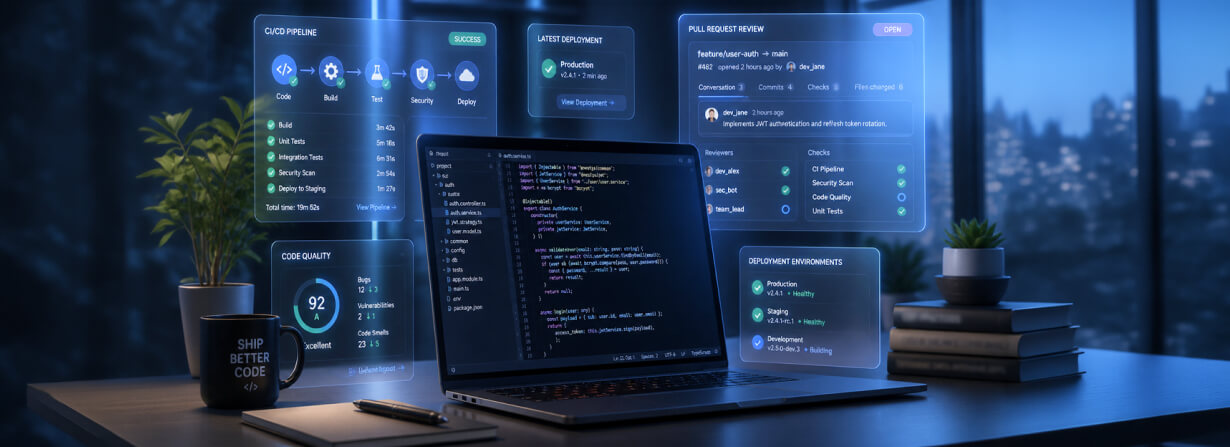
Agent embedded in CI/CD pipeline — writing unit tests for new functions, reviewing PRs against style guide rules, generating changelogs, and flagging potential regression risks.
Outcome:
PR review cycle time reduced by 34%; test coverage on new code increased from 61% to 89%.

Agent extracting structured data from invoices, contracts, and financial statements — classifying document type, extracting key fields, validating against business rules, and routing exceptions for human review.
Outcome:
Processing time per document reduced from 22 minutes to 90 seconds; exception rate of 4% routed to human review.



















Our AI agent development services include workflow discovery, agent architecture, prompt orchestration, tool calling, function calling, API integration, memory design, Retrieval-Augmented Generation (RAG), evaluation harnesses, and deployment pipelines. We also build guardrails, fallback logic, audit logs, observability dashboards, and human-in-the-loop controls for reliable production execution.
Our AI workflow automation services support multi-step workflows such as lead enrichment, ticket triage, document extraction, invoice validation, CRM updates, report generation, and internal data lookup. Agents can connect with REST APIs, GraphQL APIs, databases, vector stores, knowledge bases, SaaS tools, and webhook-based systems.
We validate agents through evaluation harnesses, golden datasets, regression tests, tool-use accuracy checks, latency benchmarks, and task-completion scoring. Each agent is tested for structured output accuracy, hallucination risk, API failure handling, fallback behavior, and edge-case coverage before production rollout.
Our multi-agent AI development approach uses orchestrator-worker patterns, role-specific agents, task routing, shared state management, structured message passing, and failure isolation. The orchestration layer manages agent coordination, context handoff, queue priority, tool access, and retry policies to keep complex workflows traceable and maintainable.
Yes. We integrate AI agents with CRMs, ERPs, databases, cloud applications, ticketing systems, document repositories, internal APIs, and third-party SaaS tools. We handle authentication, OAuth flows, rate limits, schema mapping, webhook events, API contracts, data validation, and secure connector development.
Our autonomous AI agent development services also include post-deployment support. We monitor production AI agents using observability dashboards, audit logging, tool-call tracing, latency tracking, token usage monitoring, cost alerts, and anomaly detection. Key metrics include task success rate, fallback frequency, escalation rate, API error rate, retry volume, response quality, and workflow completion time.


Since 1999, SunTec has been a trusted business process and software engineering partner for technology companies worldwide. Our team of over 1,500 full-time employees delivers innovative services every day to help our clients save time and money.


