AI is no longer a nice-to-have for delivering remarkable customer support; it is mission-critical. In fact,
Over 70%[1] of customer experience (CX) leaders deem conversational AI chatbots to be skilled architects in personalizing user journeys, shaping interactions, and making customer service feel both seamless and efficient.
More than 72%[1] of them believe that AI Agents are evolving into an extension of their brand, mirroring the intent, voice, and value when engaging with their customers.
With AI-powered customer support transforming how businesses respond to and engage with their target audiences, it is clear that the future (rather, the present) lies in embracing AI in the customer service loop. Whether to provide instant solutions with off-the-shelf chatbots or to offer tailored, contextual assistance through agentic workflows, AI has become fundamental to customer support success.
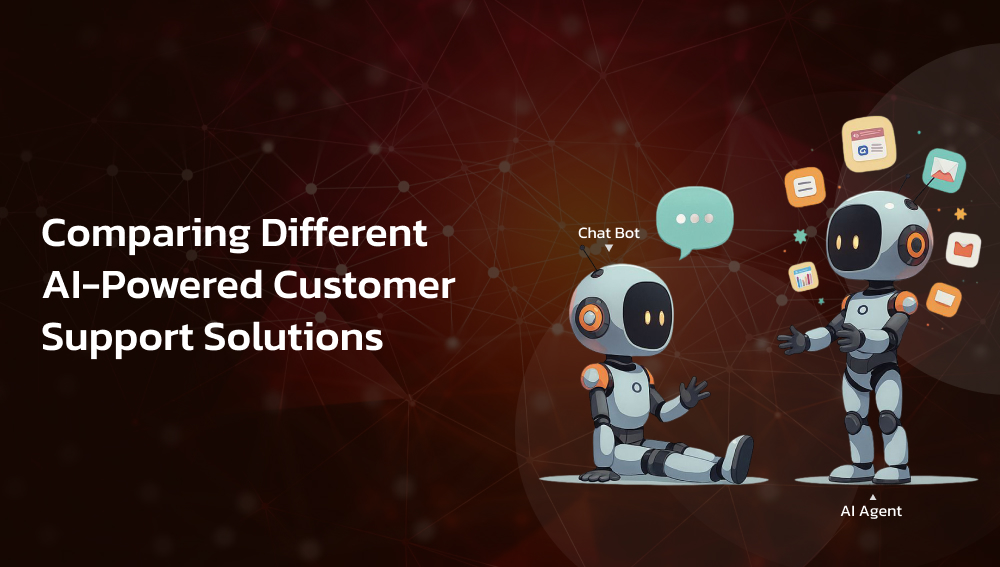
This also raises an important question: Which AI-powered customer support solution suits your business? Let us unpack the difference between conversational chatbots and AI Agents to help you determine an ideal solution.
Conversational Chatbots vs. AI Agents: Key Difference
You must have come across an online pop-up bot when shopping online or visiting a website. You ask questions, and it provides answers instantly. This is a conversational chatbot—a digital customer support rep that understands and responds to consumer queries 24/7.
Conversational service chatbots shine when:
- Answering questions like, “What are your working hours?” or “Where can I find X?”
- Helping users complete basic actions, such as placing an order.
- Guiding users through processes such as password resets or subscription management.
Now, let us say a customer is stuck with a more complex, multi-step problem, such as troubleshooting a malfunctioning product. They raise a query via live chat in order to seek assistance. To autonomously address this situation, an AI Agent steps in, assesses the issue, gathers necessary details, and initiates the entire troubleshooting process without any manual intervention or approval.
This AI Agent could:
- Ask follow-up questions (autonomously) to narrow down the problem
- Run necessary diagnostic tests on real-time data
- Close live support tickets by offering the best possible solutions, which could be scheduling an appointment for technician support or replacing the product
Technical Differentiation
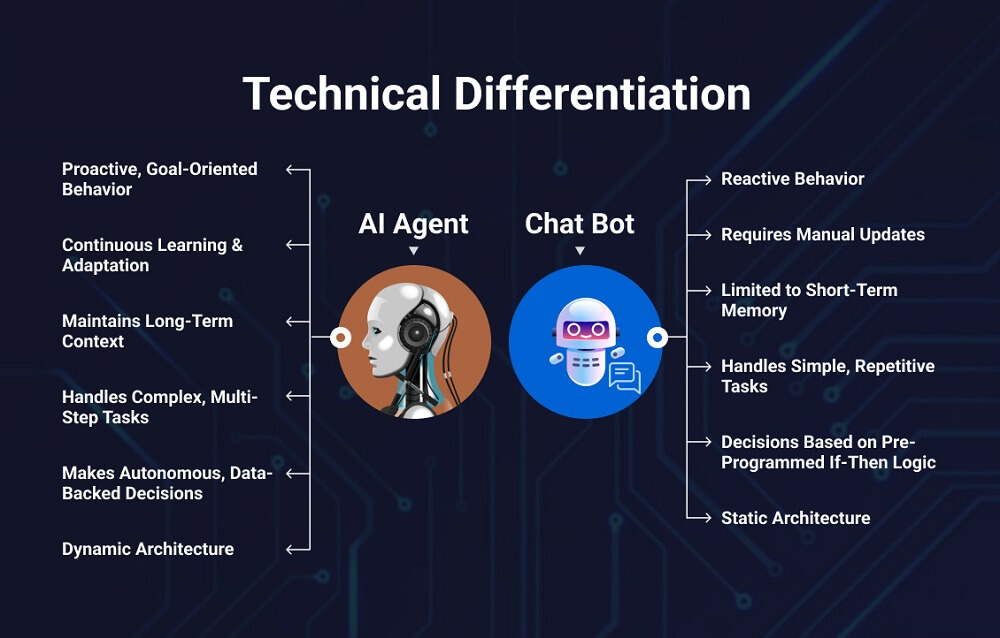
AI Agents vs. Conversational Chatbot: Which is the Ideal AI Support for your Business?
1. Core Functionality
If you want to integrate AI-powered customer support solutions that only take over pre-defined, query-response processes, or to impart basic information to all visitors, go for a conversational AI chatbot. Conversely, if you want the AI solution to handle more dynamic, multi-step tasks that may require it to act autonomously, AI Agent workflow automation is advisable.
Winner: If your needs go beyond basic queries, AI Agents are the better option.
2. Ease of Implementation
For quick fixes or AI-powered customer support solutions that are typically easier to deploy, integrate pre-programmed conversational chatbots. If you have more time and resources at hand and your workflows are layered, integrate enterprise AI Agent solutions.
Winner: For quick deployment and minimal implementation complexity, conversational AI chatbots are the clear choice.
3. Scope of Customization/Personalization
If personalization or custom support is not something that you seek, a basic, off-the-shelf conversational AI chatbot would suffice for your operations or workflows. For example, if you are okay with your AI-powered customer support solution addressing users by name but providing a standard answer to everybody, then integrate chatbots. Similarly, if you need a solution that learns with each user interaction and tailors responses, implement AI Agent workflow automation.
Winner: AI Agents are the clear winner here for businesses that prioritize personalization and dynamic responses.
4. Ability to Handle Complex Scenarios
Simple, static, and one-time queries are easily handled by conversational chatbots. So if your AI-powered customer support solution is expected to perform only basic tasks, like checking request status, then go for a conversational chatbot. When you need it to be capable of managing multi-step processes, complex queries, and even engaging in conversations that require deep context understanding and learning, AI Agent workflow automation would be better.
Winner: For handling intricate workflows and tasks, AI Agents clearly outperform chatbots.
5. Cost Considerations
Conversational chatbots are typically a more cost-effective AI-powered customer support solution due to their ease of development and integration, and their limited functionality. Their setup costs can range from $1,000 to $10,000, depending on requirements. Additionally, monthly maintenance is modest unless you need more features, custom model training, or prompt engineering support.
However, depending on the complexity and size of the AI-powered customer support solution being implemented, the initial costs of AI Agents can range from $10,000 for basic systems to $100,000+ for Agentic ecosystems. Given that AI Agents require advanced skills like context-augmented information retrieval and predictive modeling, this cost is higher.
Winner: Chatbots are more cost-effective for minor, simpler use cases.
6. Data Handling and Insights Generation Capabilities
Given that conversational chatbots have limited data analysis capabilities, they would be sufficient if you only need basic reporting. Chatbots can only display this data; they cannot analyze it and derive any valid conclusions from it. You should instead implement Agentic AI workflow automation if your use case is more complex, such as recording previous user interactions, analyzing them to identify trends, and expecting your AI-powered customer support solution to reroute accordingly.
Winner: AI Agents excel at generating actionable insights and leveraging data for continuous improvement.
Summarizing the Comparison: AI Agents vs. Chatbots
| Parameter | Conversational AI Chatbots | AI Agents |
|---|---|---|
| Core Functionality | Handles pre-defined queries, basic info | Manages dynamic, multi-step tasks, autonomous actions |
| Ease of Implementation | Quick deployment, minimal complexity | Requires more time and resources for complex workflows |
| Scope of Customization/Personalization | Limited personalization, basic responses | Highly customizable, learns from interactions, offers dynamic responses |
| Ability to Handle Complex Scenarios | Handles simple, static tasks | Manages multi-step, complex workflows and deep context understanding |
| Cost Considerations | Cost-effective, setup $1,000–$10,000 | Higher costs, setup $10,000–$100,000+ depending on complexity |
| Data Handling & Insights | Limited reporting, no actionable insights | Advanced data analysis, generates actionable insights |
| Security & Compliance | Basic security protocols, limited to basic data | Superior security, integrates enterprise-grade data protection |
| Evolution | Requires frequent updates for minor changes | Continuously understands, learns, and acts, even when the requirement evolves |
Will Conversational Chatbots Be Replaced by AI Agents?
Now that we have seen the core difference between chatbots and AI Agents, some people may wonder whether AI Agents will replace chatbots, given their superior performance, contextual understanding, and data security promises.
However, in reality, AI Agent workflow automation is unlikely to fully replace conversational chatbots. Instead, you can expect hybrid AI-powered customer support solutions where both chatbots and AI Agents co-exist. Here’s why:
→ Conversational chatbots, offering highly effective customer support, can take over high-volume consumer queries without requiring deep learning or complex decision-making capabilities.
→ AI Agents, having next-level capabilities, handle dynamic and multi-step tasks in environments where customers expect a deeper and humanized support experience.
Hybrid Approach: Many companies use a hybrid approach, employing AI Agents for more complex customer support and chatbots for simpler questions.
The Result:
- Enhanced process automation efficiency
- Better, more relatable support for your customers
When to Choose Chatbots vs. AI Agents?
Your company’s needs and the ultimate objectives of your customer support automation will determine whether you should use conversational AI chatbots or AI Agents.
Chatbots are the best option if you’re searching for rapid, practical solutions for straightforward tasks.
AI Agents are a better option for more context-driven support that calls for multi-step workflows and personalization.
If you’re unsure which category your operations fall in, our AI development company can help. We have seasoned consultants who can evaluate your workflows and assess AI readiness to determine the ideal solution. Whether it is an AI Agent, a conversational chatbot, or typical API integration with tools like ChatGPT, Claude, etc., we can make it happen. Regardless of the solution you implement, our focus remains on helping you deliver reliable customer support and maximum user satisfaction.
We also offer flexible engagement options if you want to hire dedicated AI developers to augment existing AI capabilities or build a custom solution internally.
Frequently Asked Questions
How do I decide whether my business needs a chatbot or an AI Agent?
It depends on your support complexity and personalization goals. If your use cases are straightforward (like FAQs, order tracking, or appointment booking), a chatbot is ideal. But if your workflows involve dynamic decisions, contextual understanding, or multi-system integration, you’ll benefit more from AI Agent workflow automation.
Can you build both chatbots and AI Agents for our business?
Absolutely. We can design and develop both conversational AI chatbots and custom AI Agents, tailored to your business logic and customer support needs. Whether you need a quick-deploy chatbot or an end-to-end AI support ecosystem that learns and adapts, we can deliver it.
What platforms or tools do you use to develop AI-powered customer support solutions?
We work with a mix of proprietary and open-source AI tools, including OpenAI GPT, Anthropic Claude, Dialogflow, Rasa, LangChain, Microsoft Bot Framework, and AWS Lex. For AI Agents, we use custom LLM orchestration frameworks and workflow automation layers that integrate conversational AI solutions with CRMs, ERPs, or ticketing systems to stream data and provide additional context.
How long does it take to implement an AI-powered customer support solution?
Basic chatbots can be deployed within 2–4 weeks, depending on the scope of training and integrations. AI Agent solutions, which require repeated model training, workflow setup, and API orchestration, may take longer—up to a few months. Regardless of the required AI customer support solution, we follow an agile deployment approach for timely delivery.
How secure are AI-powered support systems?
We design every solution with enterprise-grade security, including data encryption, access control, and compliance with GDPR, SOC 2, and ISO 27001. Our AI/MLOps pipelines also include built-in audit trails and version control for maximum transparency.
Can AI Agents be trained using our company’s proprietary data?
Yes. We can fine-tune your AI Agents using internal knowledge bases, FAQs, chat logs, and product data while maintaining strict data privacy. This allows your AI to reflect your brand tone, industry context, and customer preferences.